Is Your First Step in the Morning Painful? You May Have Plantar Fasciitis — And Shockwave Therapy Can Help

Updated: Jul 10
That First Step Out of Bed Shouldn't Feel Like Walking on Broken Glass
You wake up in the morning, swing your legs over the side of the bed, and the moment your foot touches the floor — sharp, stabbing pain shoots through your heel.
You limp to the bathroom. After a few minutes of walking around, it eases up a little. But it comes back when you've been sitting for a while and stand up again. And if you've been on your feet all day, by evening your heel is throbbing.
Sound familiar?
If it does, there's a very good chance you have plantar fasciitis — one of the most common causes of heel pain in adults. It affects more than 2 million Americans every year. And for many people, it becomes a frustrating, months-long struggle that doesn't respond well to rest, stretching, or standard treatments.
The good news is that there is a highly effective, non-surgical option that has helped thousands of patients get lasting relief — including many patients right here at Oasis Chiropractic & Wellness Center in Cottage Grove, Minnesota.
It's called OmniWave Shockwave Regenerative Therapy. And if you've been dealing with chronic heel pain, it may be exactly what your body needs to finally heal.
What Is Plantar Fasciitis?
The plantar fascia is a thick band of connective tissue that runs along the bottom of your foot — connecting your heel bone (calcaneus) to the base of your toes. Its job is to support the arch of your foot and absorb the impact of every step you take.
When that tissue becomes irritated, overstressed, or damaged, it becomes inflamed and painful. That's plantar fasciitis.
The word "fasciitis" means inflammation of the fascia. But here's what many patients — and even some providers — don't fully appreciate: in many chronic cases, the tissue isn't just inflamed. It has undergone degenerative changes. The tissue structure breaks down, micro-tears develop, and the normal healing process stalls out.
This is why plantar fasciitis that has been present for several months often doesn't respond well to anti-inflammatory approaches like cortisone injections or ice. The problem has shifted from acute inflammation to chronic tissue degeneration — and that requires a different kind of treatment.
What Causes Plantar Fasciitis?
Plantar fasciitis develops when the plantar fascia is subjected to more stress than it can handle over time. Several factors contribute to this:
Biomechanical Factors:
Flat feet (overpronation) — causes the fascia to stretch abnormally with every step
High arches — puts excessive strain on the heel attachment
Tight calf muscles or Achilles tendon — increases tension on the plantar fascia
Poor foot mechanics or gait abnormalities
Activity and Lifestyle Factors:
Sudden increase in activity — a new workout program, training for a race, or a job that requires long hours on your feet
Running, especially on hard surfaces
Standing for long periods on concrete or hard floors
Walking barefoot consistently on hard surfaces
Other Contributing Factors:
Being between ages 40 and 60 (tissue elasticity decreases with age)
Excess body weight — increases load on the plantar fascia
Worn-out shoes without proper arch support
Previous heel or foot injuries
Athletes and active adults in the Cottage Grove and South Metro area are especially prone to plantar fasciitis — particularly runners, cyclists, youth sports coaches, and anyone who spends long days on their feet. Our Sports & Performance Care program regularly works with patients in exactly these situations.
The Classic Symptoms of Plantar Fasciitis
Plantar fasciitis has a very recognizable symptom pattern. If you recognize these, it's time to get it properly evaluated:
The Most Common Symptoms:
Sharp, stabbing heel pain with the first steps in the morning — often described as "stepping on a nail"
Pain that is worst first thing in the morning or after sitting or resting for a period of time
Pain that eases slightly after walking for a few minutes but returns with prolonged activity
Tenderness along the bottom of the heel, especially at the point where the fascia attaches to the heel bone
Aching or throbbing in the heel after standing for long periods
Stiffness in the foot and heel, especially in the morning
What Makes It Different From Other Heel Pain:
The "first step" pattern is one of the most reliable indicators of plantar fasciitis. The pain is most intense after a period of rest because the fascia tightens and shortens when you're not bearing weight. The moment you put weight on it, the tight tissue is suddenly stretched — and that's what causes that sharp, immediate pain.
If your heel pain is constant rather than worst after rest, or if it radiates up your leg, there may be other contributing factors worth evaluating. We assess this thoroughly at our Cottage Grove clinic before recommending a treatment plan.
Why Plantar Fasciitis Is So Hard to Treat — And Why It Keeps Coming Back
Here's the frustrating reality that many plantar fasciitis patients know all too well: standard treatments often provide only temporary relief, and the problem keeps coming back.
Why does this happen?
The Blood Supply Problem
Tendons and fascial tissue have relatively poor blood supply compared to muscles. This means they heal slowly — and when the tissue becomes chronically damaged, healing can essentially stop. The body simply isn't getting enough circulation to the area to repair the damage.
The Degenerative Cycle
In chronic plantar fasciitis, the tissue isn't just inflamed — it's degenerated. Collagen fibers become disorganized. Micro-tears accumulate. The tissue loses its normal structural integrity. Anti-inflammatory treatments don't fix degenerated tissue — they can only temporarily reduce the symptoms.
The Rest Trap
Many patients are told to rest and avoid activity. Rest can reduce irritation short-term, but it doesn't stimulate healing in degenerated tissue. When you return to activity, the same weak, degenerated tissue is still there — and the cycle starts again.
Cortisone Injections
Cortisone can provide meaningful short-term relief, but multiple studies show that repeated cortisone injections can actually weaken the plantar fascia over time — increasing the risk of plantar fascia rupture. They suppress inflammation but do not repair the underlying tissue damage.
This is why so many plantar fasciitis patients feel like they've tried everything — and still aren't better. The treatments they've tried were managing symptoms, not healing the tissue.
How OmniWave Shockwave Therapy Treats Plantar Fasciitis Differently
For a full overview of how OmniWave works, see our Complete Guide to OmniWave Shockwave Regenerative Therapy in Cottage Grove, MN.
OmniWave Shockwave Therapy works differently from every other plantar fasciitis treatment — because it targets the root problem: degenerated, poorly healing tissue.
Here's what happens at the tissue level when OmniWave shockwaves are applied to the plantar fascia:
It Restarts the Healing Process
The focused acoustic waves from OmniWave create a controlled microtrauma response in the treated tissue. This signals the body that healing is needed — triggering the release of growth factors and initiating cellular repair in tissue that has been stuck in a degenerative state.
It Increases Blood Flow to the Area
OmniWave stimulates the formation of new blood vessels (neovascularization) in the plantar fascia. More blood flow means more oxygen and nutrients reaching the damaged tissue — giving it the raw materials needed to actually heal.
It Breaks Down Calcifications
In some cases of chronic plantar fasciitis, calcium deposits form at the heel attachment. OmniWave shockwaves mechanically break these deposits down so the body can reabsorb and clear them — removing a physical barrier to healing.
It Reduces Substance P
Substance P is a key neurotransmitter involved in chronic pain signaling. OmniWave shockwaves reduce substance P levels in the treated tissue — providing pain relief that goes beyond just masking symptoms.
It Stimulates Collagen Remodeling
Shockwave therapy promotes the production of organized, healthy collagen fibers — restoring the structural integrity of the plantar fascia so it can handle load without tearing.
The result is tissue that is actually healed — not just temporarily quieted down.
What Does the Research Say?
Shockwave therapy for plantar fasciitis is one of the most well-researched applications of this technology. The evidence is strong and consistent across multiple high-quality studies.
A 2024 systematic review and meta-analysis published in a peer-reviewed journal examined 15 randomized controlled trials involving over 1,100 patients with plantar fasciitis treated with extracorporeal shockwave therapy. The results showed significant improvements in pain scores and functional outcomes compared to other conservative treatments.
A 2023 randomized controlled trial comparing shockwave therapy to platelet-rich plasma (PRP) injections for chronic plantar fasciitis found that both treatments produced meaningful improvements — with shockwave therapy demonstrating strong long-term efficacy with no injection-related risks.
A 2024 systematic review and meta-analysis examining ESWT tolerability and efficacy found that shockwave therapy is well-tolerated by the vast majority of patients, with high adherence rates and low dropout due to side effects — supporting its use as a first-line treatment for plantar fasciopathy.
Clinical success rates for shockwave therapy in plantar fasciitis consistently range from 65 to 91% across published literature — making it one of the most effective non-surgical treatments available for this condition.
For patients who have failed conservative care — stretching, orthotics, physical therapy, and cortisone injections — shockwave therapy is widely recognized as the next logical step before considering surgery.
What to Expect During OmniWave Treatment for Plantar Fasciitis at Oasis Chiropractic
Patients are often surprised by how straightforward and comfortable the experience is. Here's exactly what happens at our Cottage Grove clinic:
Your Initial Consultation
Before we begin treatment, we take a thorough history of your heel pain — how long you've had it, what you've tried, what makes it better or worse, and your activity level and goals. We examine your foot, assess your gait and biomechanics, and confirm that OmniWave is the right fit for your situation.
Preparing for Treatment
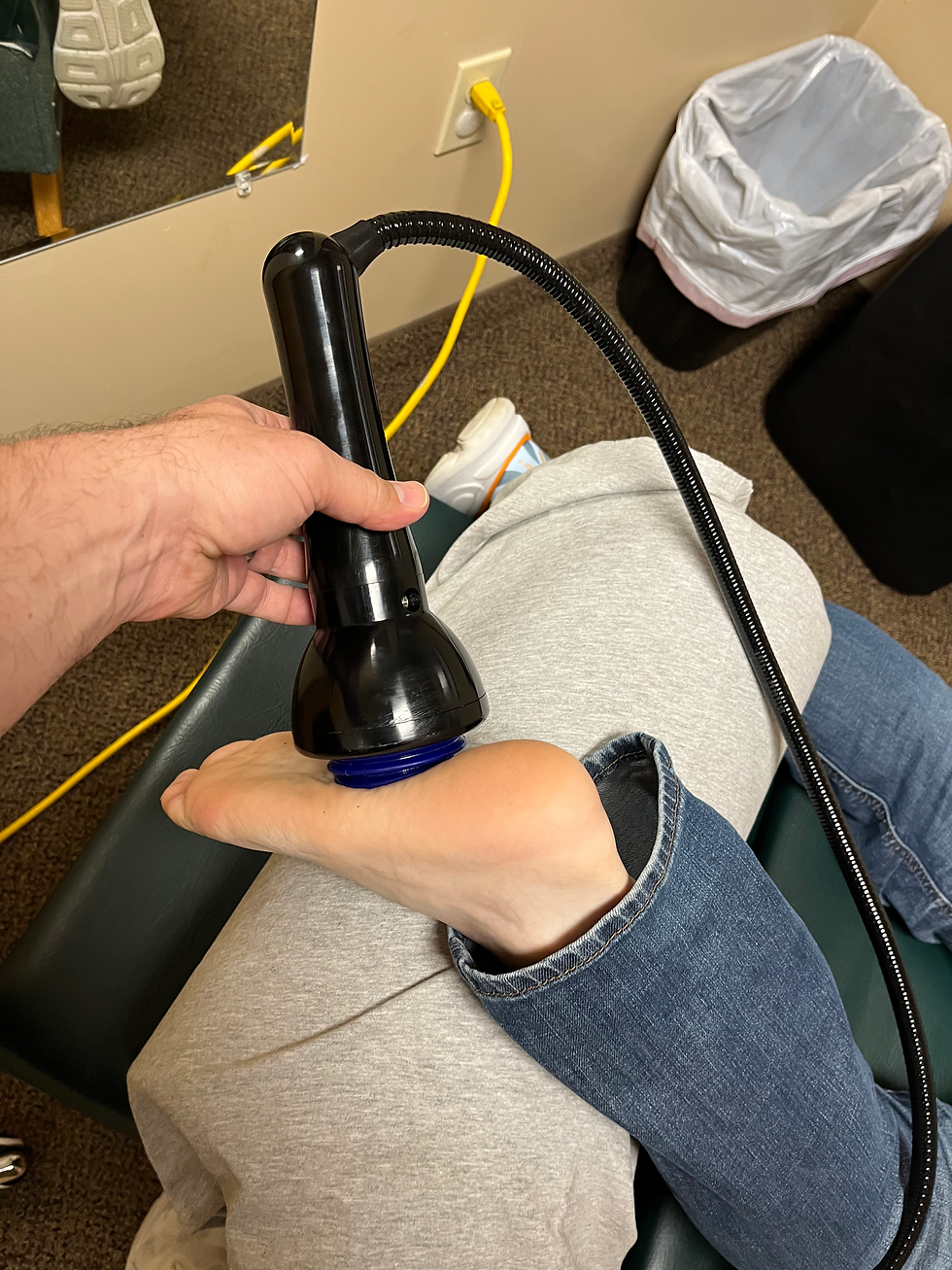
You'll be comfortably positioned with your foot accessible. A small amount of coupling gel is applied to the heel — the same type used during an ultrasound. This ensures the acoustic waves transfer efficiently into the plantar fascia.
The Treatment Itself
The OmniWave handpiece is applied gently to the bottom of your heel and the attachment point of the plantar fascia. You'll feel a pulsing or tapping sensation as the acoustic waves are delivered.
Most patients find this very manageable — significantly more comfortable than older shockwave devices. The OmniWave system's Comfort Modular Technology™ (CMT) and DepthFlex™ adjustable depth targeting allow us to deliver effective treatment at the precise depth of the plantar fascia while minimizing discomfort. The device also operates much more quietly than older shockwave machines — making for a calmer overall experience.
Each session takes approximately 20 to 30 minutes.
After Your Session
There is no downtime. You can return to normal activities the same day. Some mild soreness in the heel for 24 to 48 hours after treatment is normal and expected — it's a sign the healing response has been activated. We recommend avoiding high-impact activity for the day of treatment but generally encourage normal movement.
How Many Sessions Will You Need?
Most plantar fasciitis patients notice improvement within the first few sessions, typically scheduled once or twice per week. Chronic cases — especially those present for a year or more — may benefit from additional sessions.
Many patients notice a reduction in that sharp morning pain within the first few sessions. Results continue to improve for weeks after treatment ends as the biological healing process progresses.
OmniWave Shockwave Therapy vs. Other Plantar
Fasciitis Treatments
Here's an honest comparison of the most common treatment options:
Stretching and Physical Therapy
Valuable for mild to moderate cases and essential for long-term prevention. But for chronic, degenerated tissue, stretching alone often isn't enough to restart the healing process.
Orthotics and Supportive Footwear
Helpful for reducing stress on the plantar fascia and correcting biomechanical contributors. Work best as part of a comprehensive plan — not as a standalone solution for chronic cases.
Cortisone Injections
Can provide short-term relief but do not heal tissue. Repeated injections may weaken the plantar fascia and increase rupture risk. Effects typically wear off within weeks to a few months.
Night Splints
Help maintain stretch on the Achilles and plantar fascia overnight. Useful as a supporting therapy but not sufficient for chronic degeneration on their own.
OmniWave Shockwave Therapy
Stimulates actual tissue healing at the cellular level. Addresses the root cause — not just the symptoms. Effects continue improving for weeks after treatment ends. No systemic side effects. No downtime. Strong clinical evidence for chronic cases.
Surgery (Plantar Fascia Release)
Reserved for severe cases that have failed all conservative options. Involves cutting a portion of the plantar fascia, which carries risks including arch collapse, nerve damage, and prolonged recovery. OmniWave shockwave therapy is specifically recommended as a step to try before considering surgery.
Preventing Plantar Fasciitis From Coming Back
Preventing plantar fasciitis from coming back often means looking beyond the heel itself. Runners and active adults may also benefit from learning how chiropractic care supports more comfortable miles after 40, especially when hip, ankle, or gait mechanics are contributing to repeated foot stress. For patients focused on stronger recovery from the inside out, our guide on testing and nutrition working together explains why healing often requires both proper movement support and the right internal support.
Getting rid of plantar fasciitis is only half the battle — keeping it from coming back is equally important. At Oasis Chiropractic in Cottage Grove, we address the underlying contributors as part of your care plan:
Footwear assessment — making sure you have adequate arch support and cushioning
Calf and Achilles flexibility — tight posterior chain muscles increase plantar fascia stress
Gait and biomechanical evaluation — identifying movement patterns that contribute to overload
Activity modification guidance — helping you return to running, sports, and activity safely
Chiropractic Adjustments — ensuring proper alignment in the foot, ankle, knee, and hip so forces are distributed normally
Gradual return to activity — structured progression so you don't re-irritate healing tissue
Who Gets Plantar Fasciitis? You're Not Alone.
Plantar fasciitis is incredibly common — and it affects people across all walks of life in Cottage Grove and throughout the South Metro area:
Runners and cyclists training for races or increasing their mileage
Youth sports parents spending long hours on sidelines and bleachers
Teachers, nurses, and healthcare workers on their feet for 8 to 12 hour shifts
Warehouse and retail workers standing on hard concrete floors all day
Weekend warriors who ramp up activity suddenly after periods of rest
Athletes in their 40s and 50s whose tissue recovery has slowed with age
No matter how you developed your plantar fasciitis — you deserve a treatment that actually heals it, not just manages it.
Schedule Your Plantar Fasciitis Consultation in Cottage Grove, MN
If you've been limping through your mornings and waiting for your heel to "just get better on its own" — it may be time for a different approach.
OmniWave Shockwave Therapy at Oasis Chiropractic & Wellness Center gives your plantar fascia the biological stimulus it needs to actually heal. Most patients see real improvement within 3 to 6 sessions — and results continue developing long after treatment ends.
We serve patients from Cottage Grove, Woodbury, St. Paul Park, Newport, Hastings, and throughout the South Metro Twin Cities area.
🦶 Your First Step Shouldn't Be the Most Painful One of the Day.
If you've been waking up to heel pain every single morning — limping to the bathroom, dreading the day ahead — you know how much plantar fasciitis affects your quality of life. Not just your foot. Your whole day.
OmniWave Shockwave Therapy at Oasis Chiropractic doesn't just calm the pain down. It heals the tissue that's been stuck in a degenerative cycle — so the results last. Most patients notice meaningful improvement within 3 to 6 sessions. And results keep developing long after treatment ends.
🌐 Book online: www.cottagegrovechiro.com
📞 Call or text: 651-458-5565
📍 7424 E Point Douglas Rd S, Cottage Grove, MN 55016
🗺️ Serving Cottage Grove, Woodbury, St. Paul Park, Newport, Hastings & the South Metro
Don't let heel pain dictate your mornings — or your life. Let's get you back on your feet.
Frequently Asked Questions About Plantar Fasciitis and Shockwave Therapy
What does plantar fasciitis feel like?
The most recognizable symptom is sharp, stabbing heel pain with your first steps in the morning or after sitting for a period of time. The pain often eases after a few minutes of walking but can return with prolonged standing or activity. Tenderness along the bottom of the heel — especially at the heel bone — is also very common.
How long does plantar fasciitis last without treatment?
Mild cases may resolve in a few months with rest and stretching. However, chronic plantar fasciitis — especially cases that have been present for 6 months or longer — often does not resolve on its own. Without addressing the underlying tissue degeneration, many patients deal with recurring or persistent pain for years.
Is shockwave therapy painful for plantar fasciitis?
Most patients describe OmniWave treatment as a gentle pulsing or tapping sensation — not painful. The OmniWave system is significantly more comfortable than older shockwave devices. Some mild soreness in the heel for 24 to 48 hours after treatment is normal and expected as part of the healing response.
How many shockwave therapy sessions do I need for plantar fasciitis?
Most patients with plantar fasciitis benefit from 3 to 6 sessions scheduled approximately once per week. Chronic cases or those involving significant calcifications may require additional sessions. We assess your progress after each session and adjust your plan accordingly.
Can shockwave therapy help if I've already had cortisone injections?
Yes. Shockwave therapy works through a completely different mechanism than cortisone injections. Many patients who have had cortisone injections — even multiple rounds — respond very well to shockwave therapy because it stimulates actual tissue healing rather than suppressing inflammation.
Is there any downtime after shockwave therapy for plantar fasciitis?
No significant downtime. Most patients return to normal daily activities the same day. We recommend avoiding high-impact activity on the day of treatment and may give specific guidance based on your activity level.
Can I keep exercising while doing shockwave therapy for plantar fasciitis?
In most cases, yes — with appropriate modifications. We'll give you specific guidance based on your condition and activity level. The goal is to keep you as active as possible while allowing the tissue to heal.
How is OmniWave different from other shockwave devices?
OmniWave features Comfort Modular Technology™ (CMT) for a more comfortable treatment experience and DepthFlex™ adjustable depth targeting to precisely reach the plantar fascia. It also operates more quietly than older shockwave devices. These features make treatment more comfortable without sacrificing effectiveness.
Will my insurance cover shockwave therapy for plantar fasciitis?
Coverage varies by insurance plan. We recommend contacting your provider and asking about ESWT (extracorporeal shockwave therapy) coverage. Our team is happy to help you navigate your options when you come in.
Where can I get shockwave therapy for plantar fasciitis near Cottage Grove, MN?
Oasis Chiropractic & Wellness Center offers OmniWave Shockwave Therapy at 7424 E Point Douglas Rd S, Cottage Grove, MN 55016. We serve patients from Cottage Grove, Woodbury, St. Paul Park, Newport, Hastings, and the greater South Metro Twin Cities area. Call or text 651-458-5565 to schedule your consultation.
References
Pandey S, et al. Extracorporeal Shockwave Therapy Versus Platelet Rich Plasma Injection in Patients of Chronic Plantar Fasciitis: A Randomized Controlled Trial. Cureus. 2023;15(1):e34430.
Pabón-Carrasco M, et al. Comparison of the Short-Term Effect between Iontophoresis and Radial Extracorporeal Shockwave Therapy in the Treatment of Plantar Fasciitis: A Randomized Controlled Trial. Healthcare. 2024;12(12):1223.
Systematic review and meta-analysis: Extracorporeal shock wave therapy shows comparative results with other modalities for the management of plantar fasciitis. ScienceDirect. 2024.
Efficacy and tolerability of extracorporeal shock wave therapy in patients with plantar fasciopathy: a systematic review with meta-analysis and meta-regression. PMC. 2024.
Ogden JA, et al. Shockwave therapy for chronic proximal plantar fasciitis. Clinical Orthopaedics and Related Research. 2001;387:47-59.
Rompe JD, et al. Shock wave application for chronic plantar fasciitis in running athletes. American Journal of Sports Medicine. 2003;31(2):268-275.
Cleveland Clinic. Plantar Fasciitis: Symptoms, Causes, and Treatment. my.clevelandclinic.org
Mayo Clinic. Plantar Fasciitis — Diagnosis and Treatment. mayoclinic.org
American Chiropractic Association. Evidence-based approaches to musculoskeletal care. acatoday.org
About the Author

Dr. Eric Hahn, DC Sports Injury & Concussion Care | Athletic Performance Specialist Oasis Chiropractic & Wellness Center — Cottage Grove, Minnesota
Dr. Eric Hahn, DC is a chiropractor at Oasis Chiropractic & Wellness Center in Cottage Grove, Minnesota, specializing in sports injury care, concussion management, and athletic performance. Dr. Hahn works with athletes, active adults, and families throughout the South Metro Twin Cities area — helping patients recover from stubborn injuries, improve function, and get back to doing what they love. He is one of the providers of OmniWave Shockwave Regenerative Therapy at Oasis Chiropractic.


Comments